1A Universal Forecasting Pipeline ★ Main idea
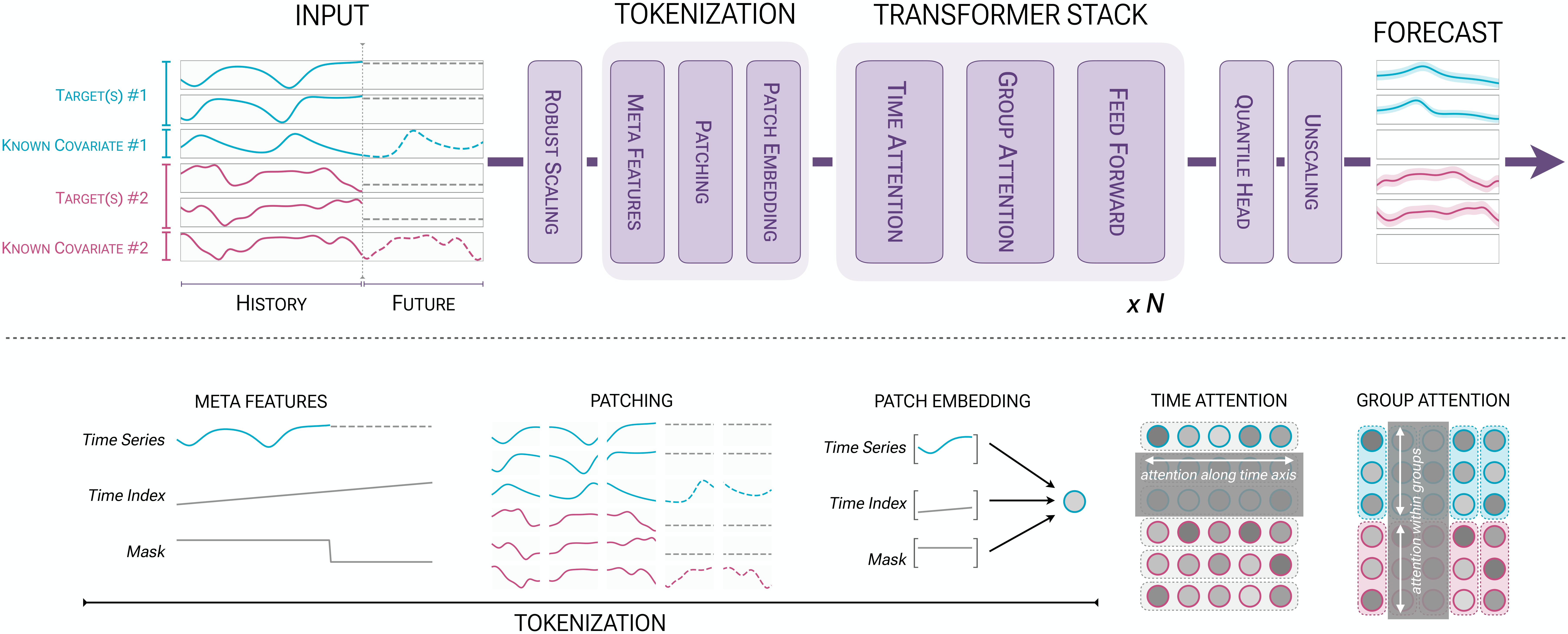
Figure 1. Chronos-2 normalizes targets and covariates, adds time and mask features, patches each series, then alternates time attention with group attention before producing direct multi-step quantile forecasts.
A group can be one series, related series, the variates of a multivariate series, or targets together with past-only and known covariates. Group attention shares information across those series at each patch index while time attention models each series across patches.
2Beyond Univariate Forecasting
Most pretrained forecasting models treat every series independently. Real deployments instead combine co-evolving targets with signals such as weather, promotions, or infrastructure metrics.
- Downstream tasks vary in dimension count and variable semantics.
- High-quality multivariate data with informative covariates is scarce.
3Group Attention Enables ICL
Each transformer block alternates two views: time attention aggregates patches within a series; group attention aggregates all series sharing a group ID at the same patch index.
Masking rule. A two-dimensional mask confines attention within each group ID.
The batch axis becomes an ICL channel, while inference memory remains linear in the total variate count.
Because series within a group have no natural ordering, group attention uses no positional embeddings.
Synthetic structure. For multivariate and covariate-informed pretraining, “multivariatizers” impose cotemporaneous or sequential dependencies on series sampled from diverse univariate generators.
Training mix. Batches mix univariate, multivariate, past-only, and known-covariate forecasting tasks.
4Zero-Shot Results ★ Higher is better
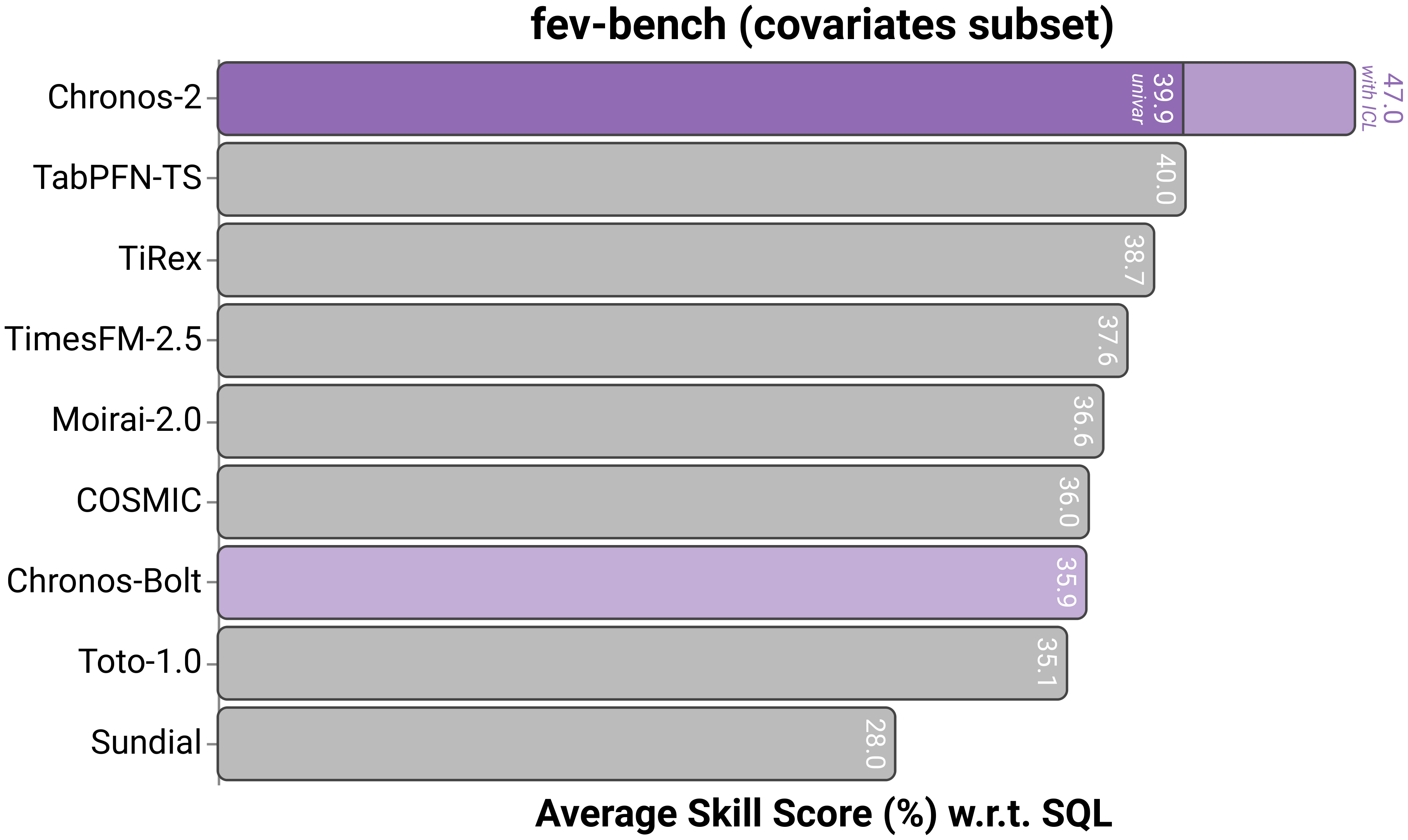
Average skill score; stacked segment shows the gain from in-context learning.
57.9%
fev-bench
multivariate
5 Takeaways
Scope.One model spans univariate, multivariate, and covariate-informed tasks.
Method.Group attention turns related series into in-context evidence.
Data.Synthetic multivariate structure supplies the missing pretraining signal.
Practical.Reports 300 series/s on one A10G: batch 1,024, context 2,048, horizon 64.
UNIVERSAL · ZERO-SHOT · FORECASTING